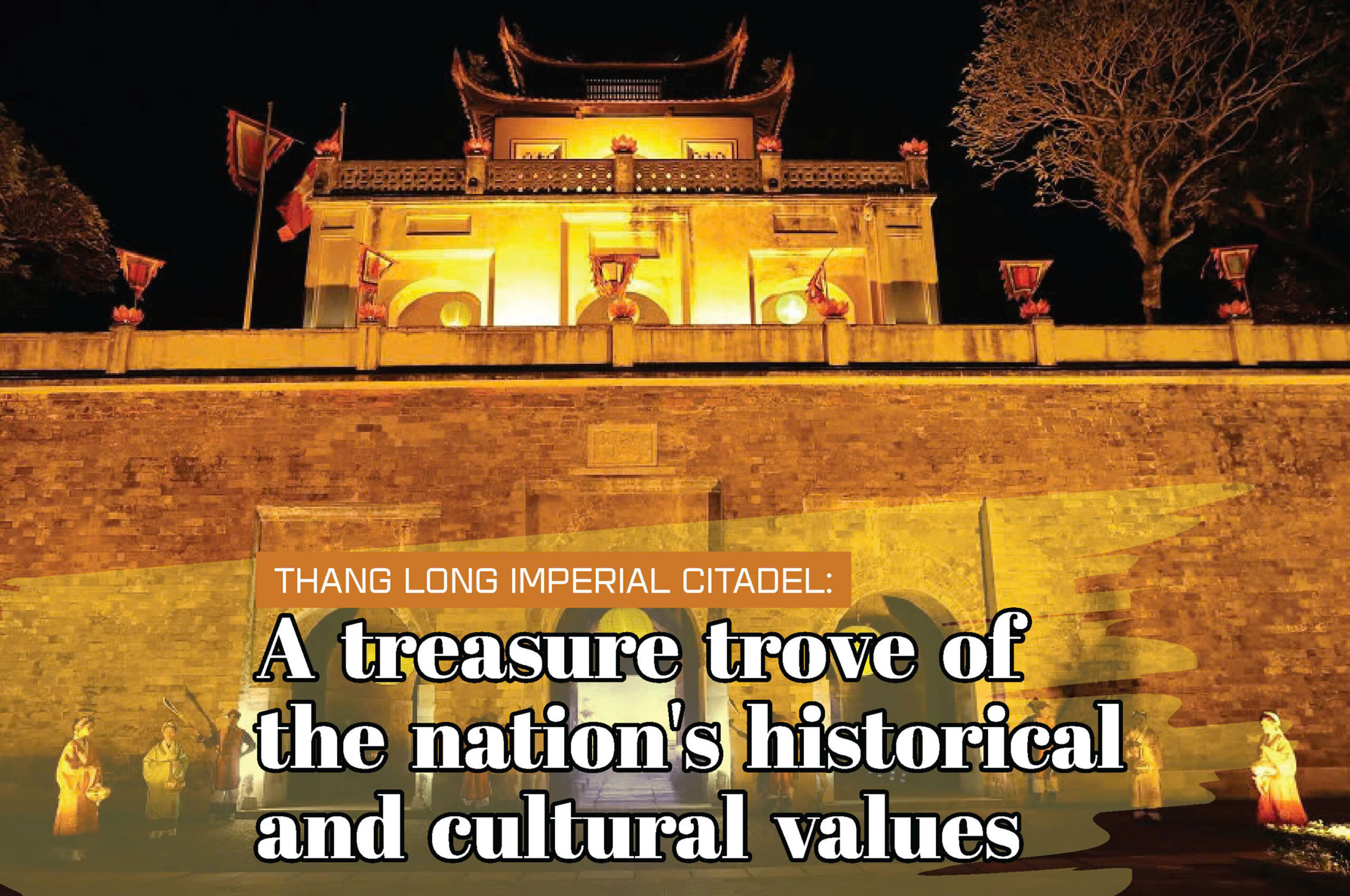
The important citadel was part of the ancient Thang Long capital which was Vietnam’s political and cultural heart for nearly 800 years from the early 11th century.
The Central Sector of the Thang Long Imperial Citadel stands as a powerful symbol of Dai Viet’s history and culture spanning over ten centuries.
It was here that royal dynasties governed the nation, where pivotal resistance wars against foreign invaders unfolded, and where the finest expressions of Vietnamese architecture and artistry converged.
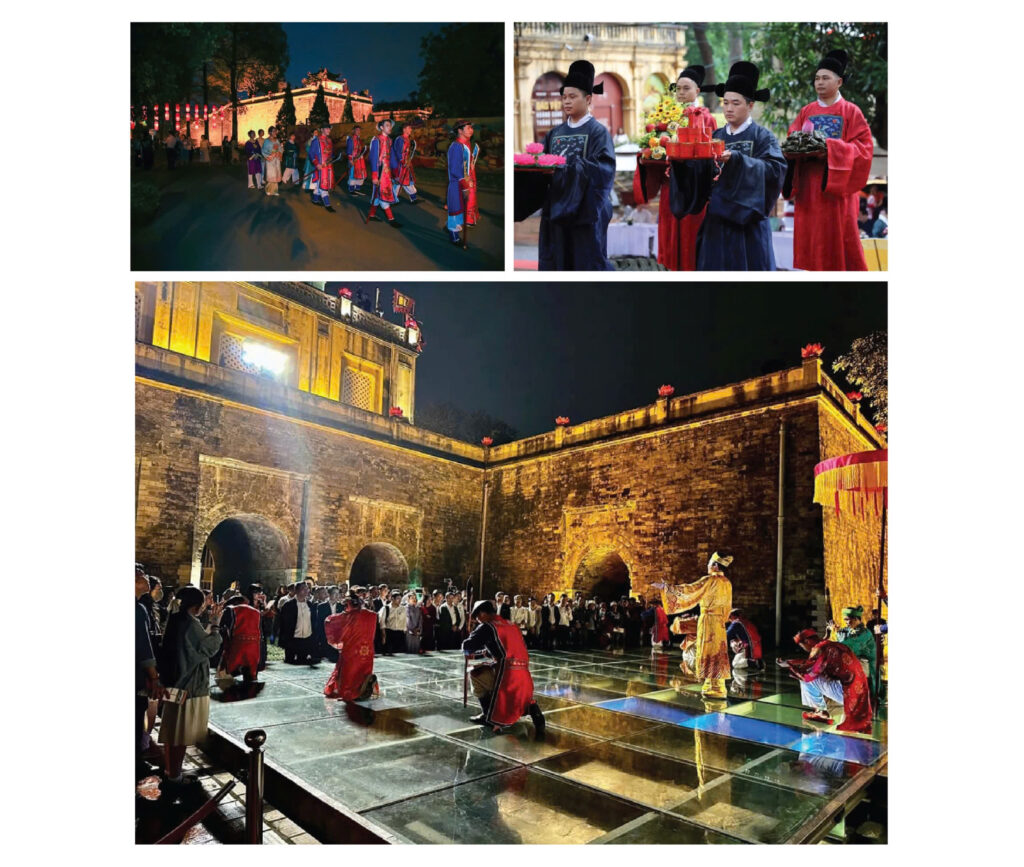
This UNESCO Heritage Site is now a favorite destination for domestic and international visitors thanks to its heritage, architecture and a deeper connection to Hanoi’s origins, offering a vivid glimpse into Vietnam’s royal past.

Despite time and war, the ancient Thang Long Imperial Citadel preserves monumental structures and echoes of its glorious past. Built on a north-south axis, the citadel’s main gate faces south, in line with traditional geomantic principles. At its heart lies the “Divine Path” or “Imperial Path,” once reserved for the emperor’s passage.
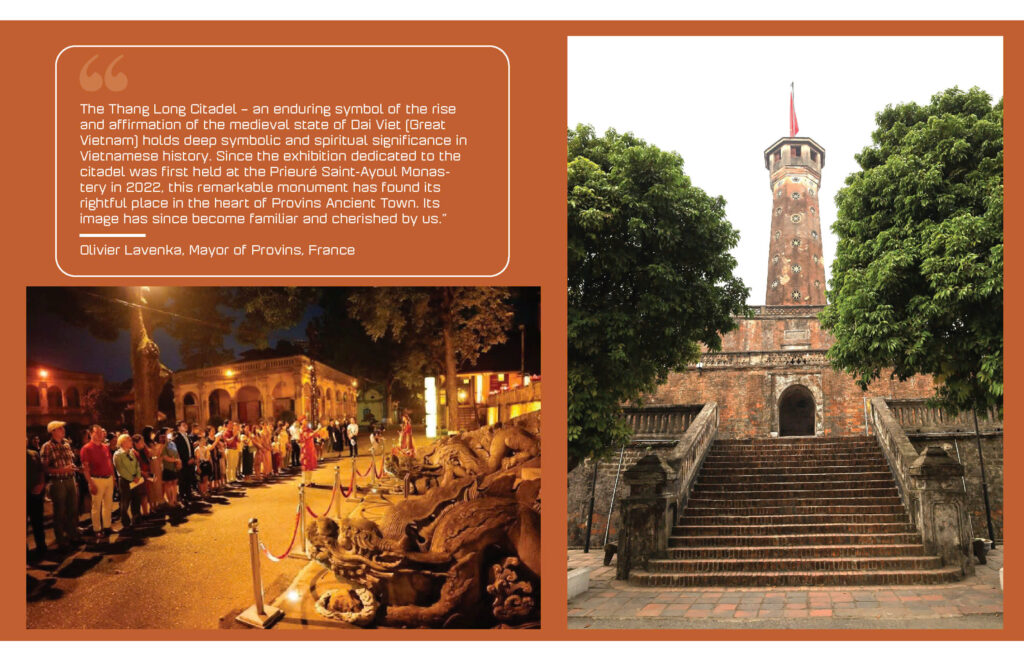
From the southern end, the first structure is the Hanoi Flag Tower, built during the Nguyen Dynasty. Standing on a three-tiered pedestal topped by a tall pillar, it reaches 33.4 meters, or 41.4 meters including the flagpole. With the national flag flying above, the tower, which was an observation post, is a symbolic landmark.
Following the Imperial Path northward, visitors reach the grand Doan Mon Gate, or South Gate, with five arched entrancesmarking the official entry into the royal citadel.
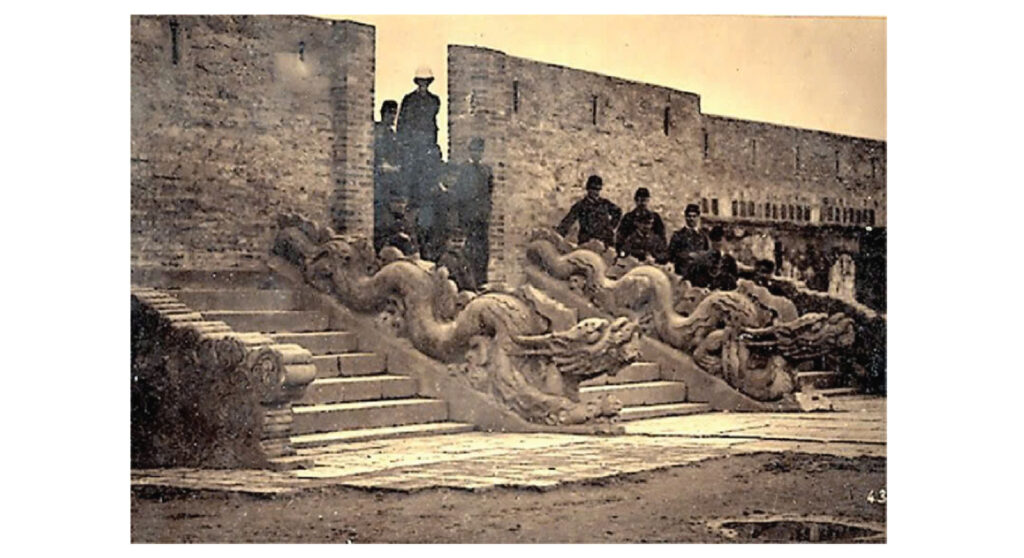
At the core of the Imperial Citadel stood Kinh Thien Palace – the Dai Viet state’s political and ceremonial center where emperors held court, received foreign envoys, and met scholars. Though the palace no longer stands, its ornate stone steps with dragon carvings from the Early Le Dynasty are well preserved, offering a glimpse of past grandeur.
The last major intact structure is the Cua Bac, or North Gate, located on Phan Dinh Phung Street. Its façade still bears two cannonball impacts from the French assault on the Hanoi Citadel in the late 19th century.
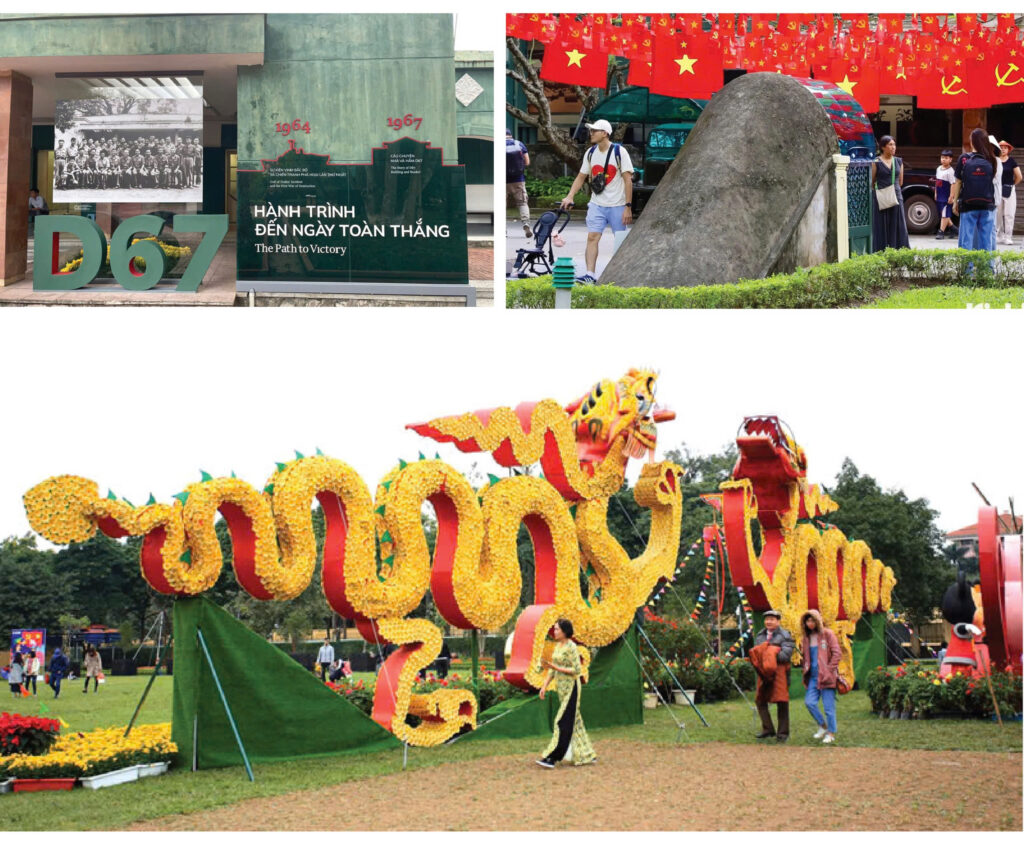
In addition to relics from the feudal era, the Thang Long Imperial Citadel also features important structures from later history, including the French colonial period and the resistance war against the United States. The most significant is the D67 House and Bunker, the meeting room of the Politburo and the Central Military Commission.
Built by the Ministry of National Defense during US air raids, this underground facility served as the General Headquarters’ command center. Nine meters below ground, key military strategies were devised here, notably the Ho Chi Minh Campaign of Spring 1975, which led to the liberation of the South and the reunification of the country.

In 1010, King Ly Thai To – the founding emperor of the Ly Dynasty (1009-1225) issued the Edict on the Transfer of the Capital, relocating the imperial seat from the mountainous Hoa Lu (in present-day Ninh Binh Province) to the Dai La Citadel, now known as Hanoi.
Historical records recount that upon the royal court’s arrival in Dai La, the king witnessed a golden dragon soaring into the sky. Interpreting this as an auspicious sign, he renamed the land Thang Long, meaning “ascending dragon.”
The new capital had two main sections, with the Thang Long Imperial Citadel – the royal residence and the administrative center of the feudal state. This area, located in today’s Ba Dinh Ward, housed the entire royal court. Over time, the court’s main ceremonial hall was named Kinh Thien Palace.
Surrounding the citadel was the civilian quarter, home to the common people. This outer city was enclosed by the imposing Dai La Citadel, serving as a protective barrier for the capital.
With historical ups and downs, Thang Long remained Vietnam’s political and cultural heart for nearly 800 years until the capital was relocated to Hue in the early 19th century under the Nguyen Dynasty.

In 2002, during the construction of the Vietnam National Assembly Building, millions of precious artifacts were discovered over an area of tens of hectares. That zone is now the 18 Hoang Dieu Street Archaeological Site.
Numerous types of architectural vestiges and relics were found stacked on top of each other over more than 1,000 years. The oldest are those from the Dai La period, when the country was still under Chinese rule from the 7th to 9th centuries, followed by findings from the Dinh and Early Le dynasties (the 10th century).
Particularly valuable is the archaeological strata related to the Ly Dynasty (1009-1225) and Tran Dynasty (1226-1400). Above these lie layers linked with the Initial Le (1428-1527), Mac (1527-1592), Revival Le (1593-1789) and Nguyen (1802-1945) dynasties.
With these special values, the Central Sector of the Thang Long Imperial Citadel, including the Ancient Citadel and 18 Hoang Dieu Street Archaeological Site, was recognized by UNESCO as a World Cultural Heritage in 2010.
“The layers of rocks, bearing the marks of all historical periods throughout 13 centuries, show an orderly continuation, without disruption. Especially the Central Sector of the Imperial Citadel and the Forbidden City of Thang Long. This area is a priceless asset of Vietnam in general, and of the capital Hanoi in particular,” said Assoc. Prof. Dr Tong Trung Tin, President of the Vietnam Archaeological Association.
Sometime after the Nguyen Dynasty established the capital in Hue, Kinh Thien Palace was demolished by French colonialists to make way for their Artillery Command Headquarters.
Over the years, archaeological excavations gradually revealed the original form of Kinh Thien Palace. A breakthrough came in 2023, when archaeologists uncovered the foundation bearing ten single column footings and seven double ones, equivalent to a total of 24 single footings in total.
Based on these findings, researchers reconstructed the likely structure of Kinh Thien Palace: nine compartments, with the central compartment 6.8 meters wide, the adjacent 5.35 meters each, and the two outermost 3.4 meters each. During the Revival Le period, the palace is estimated to have covered approximately 1,485 square meters.
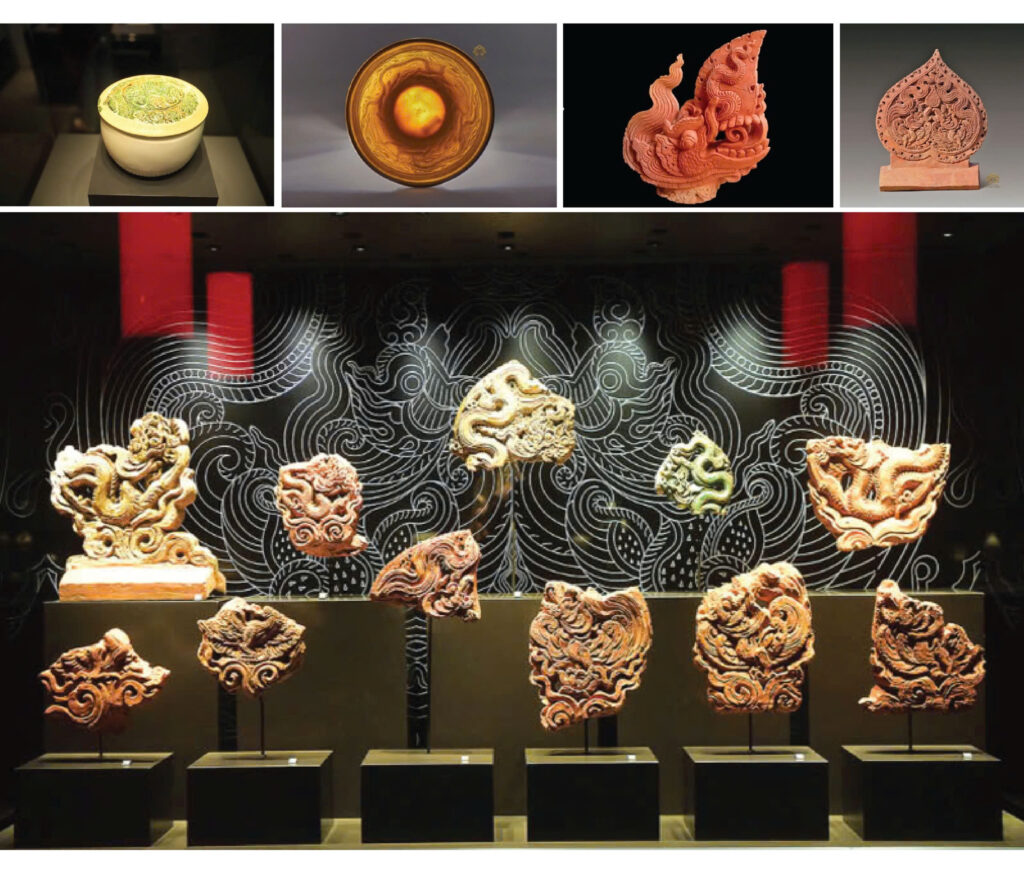
Unlike the typical unglazed fish-scale or shoe-tip tiles on religious structures still standing today, Kinh Thien Palace was roofed with yellow-glazed tube tiles – yellow being the color traditionally reserved for royalty. Each tile on the eaves was uniquely crafted: the first bore a dragon head, the following ones formed its body, and those at the top shaped its tail. Together, they created the mesmerizing image of dragons, symbolizing imperial power and vitality.
“Although a complete dau cung (interlocking wooden bracket system) has yet to be found, by combining archaeological evidence, ceramic depictions and textual records of Early Le Dynasty architecture, the Institute of Imperial Citadel Studies now confidently classifies Kinh Thien Palace as a dau cung-style structure,” said Associate Prof. Dr. Bui Minh Tri of the Vietnam Academy of Social Sciences, who has led in-depth research on the palace’s original framework and roofing system.
“This is a significant discovery- a vital key to unlocking the architectural mysteries of Kinh Thien Palace,” he added.
Today, for visitors walking through the Thang Long Imperial Citadel, the grandeur of ancient architecture can be hard to visualize. Much of the structure has been ruined, leaving only hints of its former majesty.
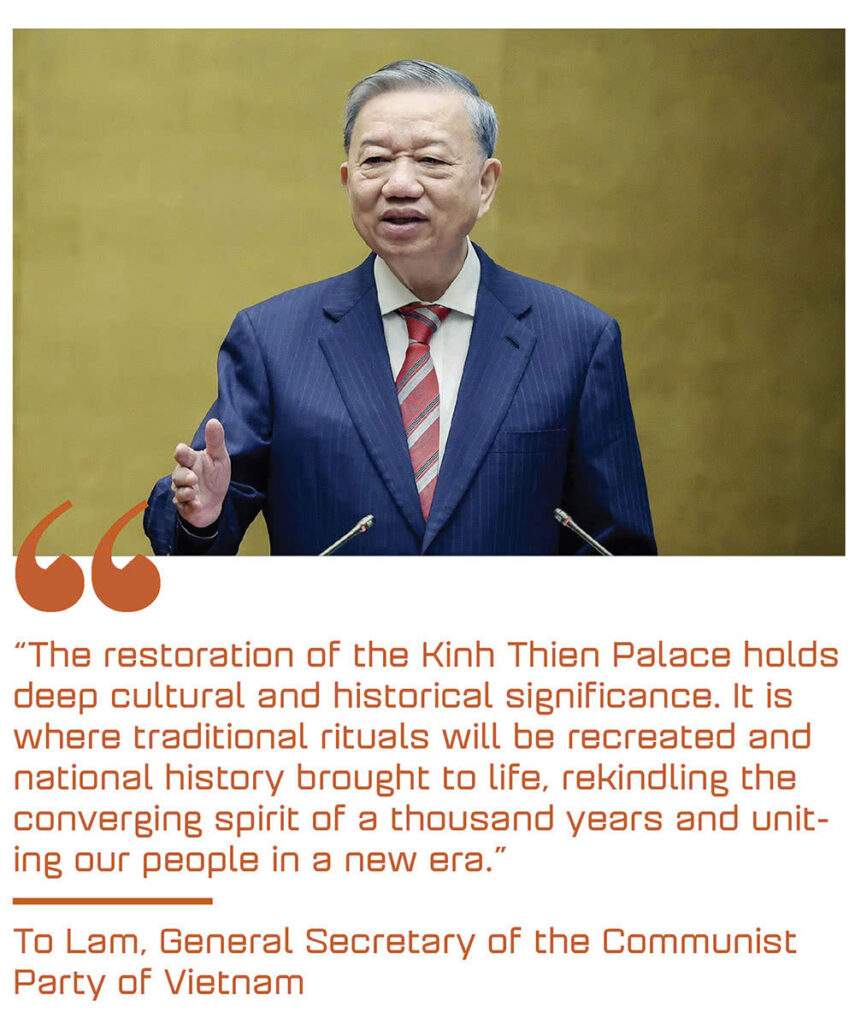
As such, Professor Nguyen Quang Ngoc and many other experts have emphasized that, given Kinh Thien Palace’s historical and cultural significance, its restoration is a cultural obligation to the people, requiring dedication in the years ahead.
As one of the capital’s most treasured heritage sites, the Thang Long Imperial Citadel ranks among Hanoi’s most compelling cultural attractions. Each year, it welcomes hundreds of thousands of domestic and international visitors.
“Exploring the Thang Long Imperial Citadel gives me a very special feeling,” shared Dinh Tuan, a tourist from Cau Giay District, Hanoi. “I hope the city continues to introduce more exciting activities to help people appreciate the value of this extraordinary heritage.”
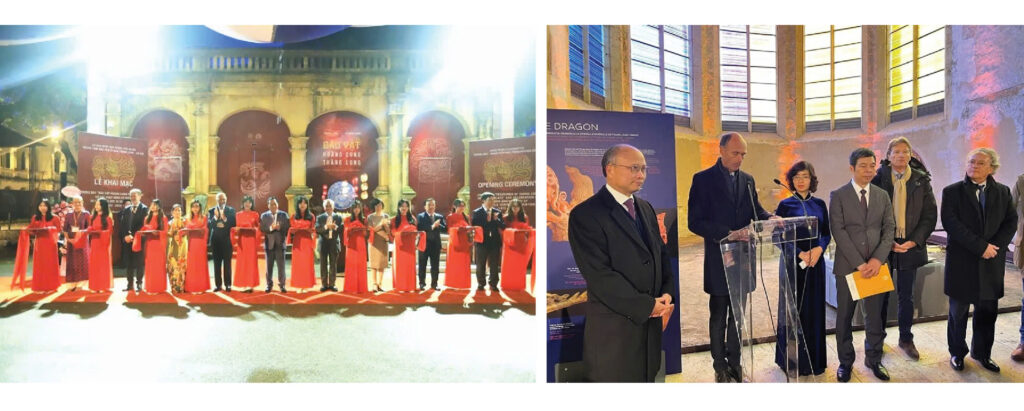
With UNESCO’s recent endorsement for the restoration of Kinh Thien Palace, the mission of preserving and promoting the Thang Long Imperial Citadel has entered an exciting new chapter. As the legacy of this sacred site unfolds, its cultural essence and historical brilliance will shine brighter, reaching new generations and crossing Vietnam’s borders.